


Full Cockpit Simulator Review: Worth the Flight?
The moment the cockpit door closes behind you, this is no longer a screen, a joystick and a pretend runway. A full cockpit simulator review has to judge the details that create genuine belief: the aircraft layout around you, the weight of the decision-making, the runway filling the windscreen and the physical sensation of the aircraft responding beneath your seat.
For anyone who has watched an Airbus disappear into the cloud and wondered what happens on the flight deck, a proper fixed-base cockpit with motion is in a different category from home simulation and arcade attractions. You are not merely playing at flying. You are taking command of a highly detailed Airbus A320 environment with an instructor beside you to turn curiosity into a memorable flight.
Full cockpit simulator review: what makes it convincing?
A convincing cockpit experience begins with the aircraft itself. In an Airbus A320 replica, the flight deck is built around the distinctive Airbus philosophy: sidesticks rather than conventional control columns, a wide instrument panel, electronic flight displays, overhead systems panels and a centre pedestal that asks for purposeful input. The switches, displays and procedures are part of the experience, not decorative scenery.
That matters because an airliner is not flown by wrestling with the controls. It is managed. You will be guided through setting up the flight, entering the departure, selecting thrust, following flight director commands and monitoring what the aircraft is doing. First-time flyers can enjoy that process without being overwhelmed, while experienced aviation enthusiasts can appreciate why crews divide tasks so carefully.
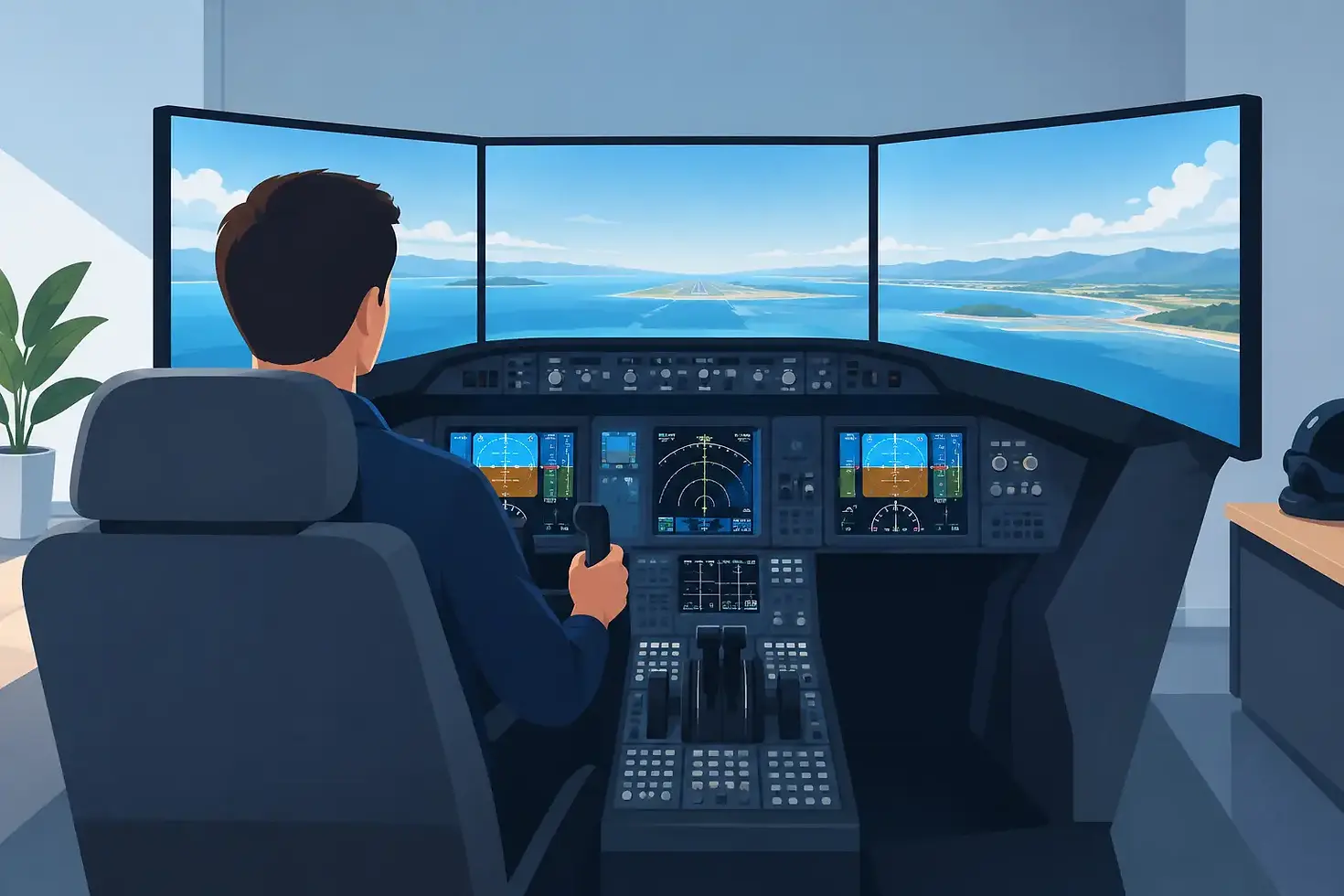
The visual system is equally important. A 220-degree HD wraparound view gives you the peripheral reference that a single flat display cannot. On approach, you can judge the runway alignment through the windscreen, see the horizon move as the aircraft banks and feel far more connected to the terrain, weather and airport environment. It changes landing from a game-like target exercise into a proper flying task.
Then there is motion. A 6-axis motion platform adds the cues that make your brain take the event seriously: acceleration on take-off, a change in attitude as the aircraft climbs, turbulence across the route and the satisfying sensation of touchdown. Motion cannot reproduce every force of real commercial flying, and it should not be presented as a substitute for an actual aircraft. But when it is paired with accurate visuals, cockpit controls and instructor-led scenarios, it delivers an astonishingly credible sense of aircraft movement.
You are the captain, but you are not left alone
The best full cockpit sessions make room for both the thrill and the learning curve. A commercial jet cockpit has more information than a casual visitor can absorb in a few minutes. That is precisely why instructor support is so valuable.
Before departure, your instructor can explain the key controls, set the scenario to suit your confidence and establish a clear plan for the flight. You might choose a straightforward departure and landing at a familiar airport, a dramatic crosswind arrival or an approach into demanding weather. The instructor handles the background complexity where needed, allowing you to focus on the moments you came for: pushing the thrust levers forward, rotating at the right speed, banking towards the departure and bringing a 70-tonne airliner back to the runway.
This approach is also what makes the experience work for mixed groups. One person may arrive with hundreds of hours on a desktop simulator, another may never have touched an aircraft control. Both can have a meaningful session. The former can ask about Airbus logic, raw-data flying or procedural flow; the latter can simply experience the power of flight with expert reassurance close by.
At Simulator Adventures in Manchester, the combination of a full replica A320 cockpit, genuine Airbus sidesticks, a 6-axis motion platform and instructor guidance is designed to keep that balance in place. The result feels ambitious without becoming inaccessible.
How it compares with home simulation and arcade flying
Home simulators can be excellent. A capable PC, quality flight controls and modern software can teach navigation, instrument scanning and aircraft systems at a fraction of the cost. For regular practice, they offer enormous value. But even a carefully built home setup rarely surrounds you with the physical scale of an airliner cockpit, the wraparound airport view or platform movement that reacts to the flight.
An arcade simulator sits at the other end of the scale. It may be fast, colourful and fun, but it typically reduces aviation to simple steering. There is nothing wrong with that for a quick attraction. It simply does not offer the same feeling of responsibility, procedure or immersion as sitting at the controls of a recreated Airbus flight deck.
A full cockpit simulator occupies the compelling middle ground. It is accessible enough for a birthday gift, a family outing or a corporate event, yet detailed enough to make knowledgeable flyers pause at the instrument panel and ask better questions. It is also far more forgiving than real flying. You can attempt a difficult approach, recover from a poor landing, reset the scenario and go again. That freedom is part of the appeal.
Is it useful for pilots as well as enthusiasts?
For a licensed, trainee or returning pilot, the answer depends on the objective. A high-fidelity leisure simulator is not automatically a regulated replacement for approved training devices, operator checks or formal type-rating requirements. Those requirements are defined by the relevant training organisation and aviation authority.
What it can provide is valuable procedural and mental rehearsal. Pilots can practise flows, build familiarity with Airbus cockpit ergonomics, refresh instrument habits, rehearse route scenarios and discuss decision-making with an instructor. It is also a cost-conscious way to spend focused time in an environment that looks and behaves far more like a commercial flight deck than a desk-based setup.
For aspiring pilots, it offers something just as useful: context. Reading about an ILS approach, flight directors or managed descent is one thing. Seeing the instruments change while the runway appears through the windscreen gives those concepts a physical reality. A simulator session will not make someone airline-ready, but it can make further training feel less abstract and far more motivating.
The trade-offs to understand before you book
Authenticity does not mean every session feels identical. The experience depends on the package length, the chosen scenario and how much you want to get involved in the technical detail. A shorter session can deliver an exhilarating take-off and landing. A longer booking gives you time to settle into the cockpit, understand the setup and attempt more than one approach.
Your preferred airport also affects the character of the flight. A clear-weather arrival may be ideal for someone’s first landing. A mountain approach, low visibility or gusty crosswind can make the same simulator feel dramatically more demanding. There is no universally best choice. The right scenario is the one that matches whether you want pure spectacle, a learning challenge or a little of both.
It is worth arriving with a simple goal. Perhaps you want to land at an airport you know, take the left-hand seat for a milestone birthday, test your nerve in rough weather or refresh your understanding of Airbus procedures. Tell the instructor. The session becomes better when it is shaped around the flight you actually want to remember.
Who will get the most from a full cockpit session?
Aviation fans will relish the chance to move beyond watching aircraft and take responsibility for one. Experience-gift buyers get something much stronger than another item in a box: a story the recipient will retell, complete with the runway they chose and the landing they attempted. Corporate groups gain a shared challenge where communication, nerve and humour all matter.
The surprise is how often non-aviation guests enjoy it too. Most people understand the drama of a take-off roll, a banking turn over a city or an approach through cloud. Once they sit in the captain’s seat and see the runway lights ahead, the technical language becomes secondary. The aircraft feels immediate.
If you want the closest thing to commanding an Airbus without leaving the ground, choose a session long enough to get past the first rush of adrenaline. Ask for the airport or weather that excites you, listen to the instructor and keep your eyes outside on final approach. The runway is waiting.


Comments